What Is a Password Manager? Everything You Need to Know (2026 Guide)
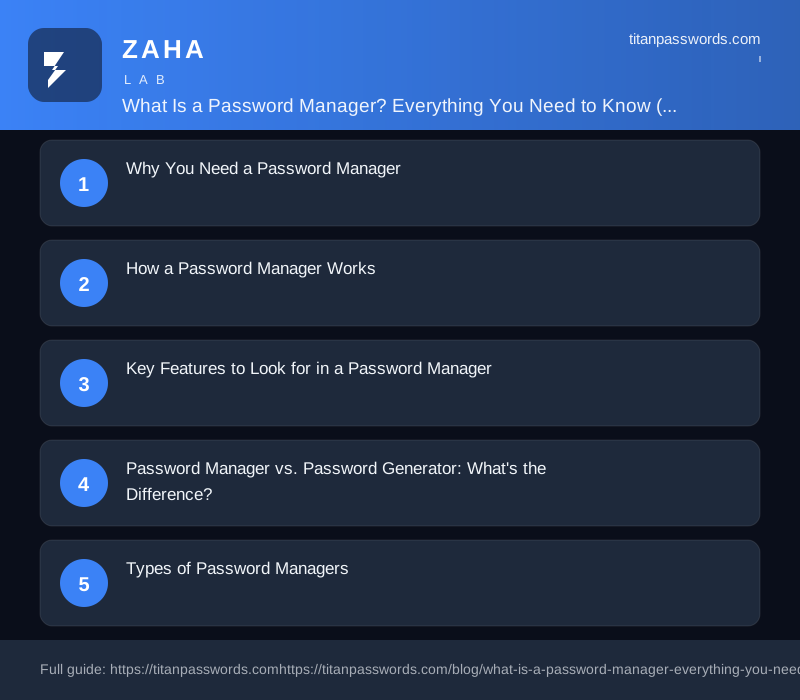
A password manager is a secure application that stores, organizes, and autofills your login credentials across websites and apps. Instead of remembering dozens of passwords — or reusing the same weak one everywhere — you remember a single master password, and the manager handles the rest.
Why You Need a Password Manager
The average person has 168 online accounts but can realistically remember fewer than 10 unique passwords. The gap is filled in one of two dangerous ways: reuse or simplification.
- - Credential stuffing attacks exploit reused passwords — one breach unlocks dozens of accounts
- - 81% of confirmed data breaches involve weak or stolen passwords (Verizon DBIR)
- - The average data breach now costs $4.88 million (IBM, 2024)
- - Reusing a password across even two accounts doubles your exposure with every breach
A password manager closes this gap by generating a strong, unique password for every account and storing it in an encrypted vault only you can open.
How a Password Manager Works
- 1. You create a master password — the only credential you must memorize
- 2. The vault encrypts everything — using AES-256 encryption; only your master password decrypts it
- 3. Autofill does the rest — browser extensions and mobile apps detect login forms and fill credentials automatically
- 4. Sync across devices — cloud-based managers keep your vault consistent on every phone, tablet, and computer
- 5. Breach monitoring alerts you — when a site you use is compromised, you get an immediate notification to change that credential
Zero-knowledge architecture means even the password manager's own servers cannot read your vault. Your master password never leaves your device in plaintext.
Key Features to Look for in a Password Manager
Core Features
| Feature | Why It Matters |
|---|---|
| AES-256 encryption | Military-grade; no practical brute-force attack exists |
| Zero-knowledge architecture | Provider cannot access your data even under legal order |
| Password generator | Creates unique 16–64 character passwords on demand |
| Autofill & autosave | Reduces friction so you actually use it |
| Browser extensions | Works with Chrome, Firefox, Safari, Edge |
| Mobile apps | iOS and Android with biometric unlock |
| Cross-device sync | Vault is consistent everywhere |
Advanced Features Worth Having
- - Breach alerts — automatic notification when a stored credential appears in a known data breach
- - Password health dashboard — surfaces weak, reused, or old passwords for remediation
- - Two-factor authentication (2FA) storage — stores TOTP codes alongside credentials for true one-stop login
- - Secure notes — encrypted storage for Wi-Fi passwords, software keys, passport numbers
- - Emergency access — trusted contact can request vault access in case of incapacitation
- - Family/team sharing — shared vaults for household accounts or business credentials without exposing master passwords
Password Manager vs. Password Generator: What's the Difference?
A password generator creates a single strong password on demand. A password manager stores and manages all of them over time.
They complement each other:
- - Use a password generator to create a strong, random password for each new account
- - Use a password manager to store, sync, and autofill that password automatically
Many password managers include a built-in generator. Standalone generators are useful when you need a quick one-off password without opening an app.
Best practice: generate with a tool → save to your manager → never type that password again.
Types of Password Managers
Cloud-Based (Most Popular)
Your encrypted vault is stored on the provider's servers. Accessible from any device. Syncs automatically. Examples: 1Password, Bitwarden, Dashlane, NordPass.
Best for: most users who need cross-device access without manual syncing.
Local/Offline
Your vault lives only on your device. No cloud = no remote attack surface, but you manage backups. Example: KeePass.
Best for: high-security users who accept the manual-sync tradeoff.
Browser-Built-In
Google Password Manager, Apple Keychain, Firefox Passwords. Convenient but locked to one ecosystem.
Best for: single-platform users who want zero friction.
Enterprise/Business
Team vaults, admin controls, SSO integration, provisioning and deprovisioning. Examples: 1Password Teams, Bitwarden Business, LastPass Teams.
Best for: companies managing credential access across employees and shared accounts.
Personal vs. Business Password Managers
| Dimension | Personal | Business |
|---|---|---|
| Primary user | Individual or family | Teams, companies |
| Vault structure | One vault per user | Shared vaults + personal vaults |
| Admin controls | None needed | Role-based access, audit logs |
| Provisioning | Self-service | IT-managed onboarding/offboarding |
| SSO/SAML | Rarely needed | Often required |
| Pricing | $3–5/month | $5–9/user/month |
How Secure Are Password Managers?
The most common objection: "Isn't all my data in one place? If that's breached, I lose everything."
The answer is architecture. With zero-knowledge encryption:
- 1. Your vault is encrypted before it leaves your device
- 2. The provider only stores ciphertext — meaningless without your master password
- 3. Even if their servers are breached, attackers get encrypted blobs, not passwords
- 4. Your master password must never be shared or stored in the cloud
Notable incidents: LastPass experienced a vault data breach in 2022. Users with strong master passwords (12+ characters, not reused) remained safe because the data was encrypted. Users with weak master passwords were at risk. This underscores the single critical rule: your master password must be long, random, and unique.
Verdict: A password manager is dramatically more secure than reused or weak passwords. The residual risk is small and concentrated entirely in your master password quality.
Choosing a Strong Master Password
Your master password is the one you must memorize. Make it:
- - At least 16 characters (20+ is better)
- - A passphrase — four to six random words are easier to remember and harder to crack than a short complex string
- - Never reused — this password should exist nowhere else
- - Backed by 2FA — add an authenticator app for a second layer
Example structure (replace words with your own random selection):
correct-horse-battery-staple-7(5 words + number = ~70 bits of entropy)
How to Get Started with a Password Manager
- 1. Choose a manager — for most people: Bitwarden (free, open-source), 1Password (premium UX), or iCloud Keychain (Apple users)
- 2. Create an account and set your master password — follow the passphrase method above
- 3. Install the browser extension and mobile app
- 4. Import existing passwords — most browsers can export a CSV; import into the manager in minutes
- 5. Enable 2FA on your manager account
- 6. Change your highest-priority passwords first — email, banking, social media
- 7. Let autosave capture new passwords — over time, the manager replaces every stored credential
Total setup time: 30–45 minutes for a thorough migration.
Password Manager FAQ
Can I use a password manager on multiple devices? Yes. Cloud-based managers sync automatically. Most allow unlimited devices even on free tiers (Bitwarden) or with a paid subscription (1Password).
What happens if I forget my master password? Most zero-knowledge managers cannot recover your master password — by design. Recovery options vary: account recovery kits (1Password), emergency contacts, or recovery codes. Set these up before you need them.
Are free password managers safe? Bitwarden is open-source, audited, and free — and a legitimate choice. Browser-built-in managers are adequate for casual use. Avoid obscure or unaudited free options.
Should I save credit card numbers in a password manager? Yes. Encrypted storage is far safer than keeping a sticky note or retyping from memory. Most managers autofill payment fields too.
What's the difference between 1Password and LastPass? Both are capable managers. 1Password has a stronger security reputation and better enterprise tooling. LastPass has been affected by high-profile breach incidents (2022). For new users, 1Password or Bitwarden are the current consensus recommendations.
Does a password manager work with passkeys? Yes. Modern managers including 1Password, Dashlane, and Bitwarden now support passkey storage and sync, making them the right place to store both legacy passwords and next-generation passkeys.
Bottom Line
A password manager is the single most impactful security tool an individual or business can adopt. The math is simple: you cannot memorize 168 unique, strong passwords — and you do not need to. One strong master password, a reputable manager, and 30 minutes of setup replaces years of credential risk.
Start with a strong password generator to create your master password, pick a manager that matches your platform and budget, and migrate over a single weekend. Your future self will not need to remember the breach that never happened.
Last updated: September 2026. Statistics sourced from Verizon 2024 DBIR, IBM Cost of a Data Breach Report 2024, and NordPass Password Statistics 2025.