Generate a banking-grade random password in your browser, then watch it checked against PCI-DSS v4.0, NIST SP 800-63B, FCA and FFIEC requirements as you go — nothing is ever transmitted.
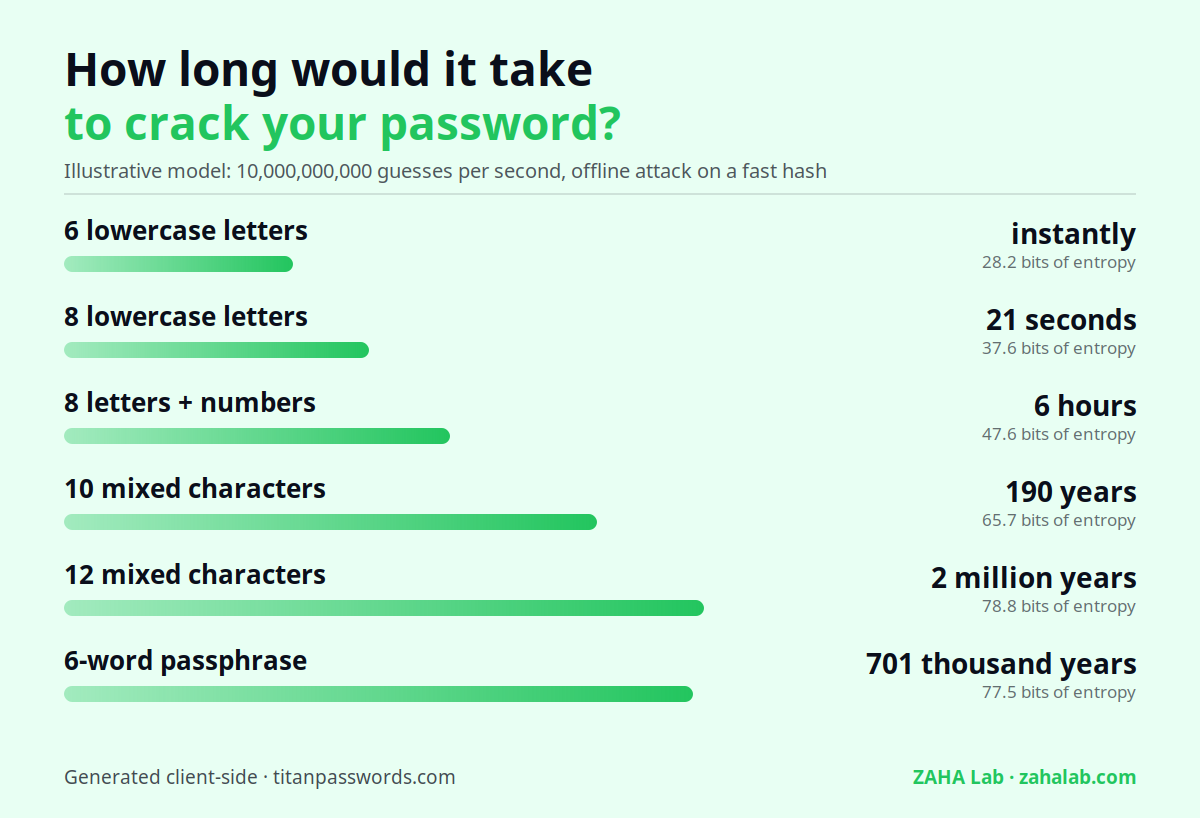
A short password falls instantly, however random it looks. The table and chart below model an offline attack at 10,000,000,000 guesses per second against a fast hash — the same maths a cracking rig actually runs.
| Password pattern | Time to crack | Entropy (bits) | Verdict |
|---|---|---|---|
| 6 lowercase letters | instantly | 28.2 | Weak |
| 8 lowercase letters | 21 seconds | 37.6 | Weak |
| 8 letters + numbers | 6 hours | 47.6 | Moderate |
| 10 mixed characters | 190 years | 65.7 | Moderate |
| 12 mixed characters | 2 million years | 78.8 | Strong |
| 6-word passphrase | 701 thousand years | 77.5 | Strong |
Assumes uniform random characters and no rate limiting. Password reuse or a breach database shortcut all of the above, which is why a unique password per account matters more than length alone.
Every preset is calibrated to the specific compliance requirements of that account type, not generic recommendations.
PCI-DSS v4.0 Req 8.3.6, NIST SP 800-63B, FCA, FFIEC, SOC 2, and NCSC, checked in real time against every generated password.
Personal Banking (20 chars), Investment Platform (24), Trading Account (28), and Business Banking (32), each meeting the compliance requirements of that account tier.
crypto.getRandomValues(), OS hardware entropy. Nothing transmitted. Verify in DevTools: zero network requests during generation.
Randomly generated unique passwords eliminate credential stuffing, responsible for the majority of financial account takeovers per Verizon DBIR 2025.
All Titan Passwords presets exceed the most stringent requirements across all listed frameworks.
| Framework | Min Length | Complexity | Rotation | MFA | Titan Compliance |
|---|---|---|---|---|---|
| PCI-DSS v4.0 Req 8.3.6 | 12 (MFA) / 15 (no MFA) | Alpha + numeric | Compromise-triggered | Required (CDE) | ✓ All presets (20–32 chars) |
| NIST SP 800-63B 2025 | 15 chars | No mandatory complexity | SHALL NOT mandate periodic | AAL2 recommended | ✓ All presets |
| FCA Operational Resilience | NIST-aligned | NIST-aligned | NIST-aligned | Required for CDE-equivalent | ✓ All presets |
| FFIEC Auth Guidance | Strong credential | Character diversity | Risk-based | Required for high-risk | ✓ All presets |
| SOC 2 Type II (CC6.1) | Implementation-defined | Implementation-defined | Risk-based | Required for privileged | ✓ All presets |
| NCSC Password Guidance | No minimum | None mandatory | Compromise-triggered | Recommended | ✓ All presets exceed |
Independently audited zero-knowledge password manager. Watchtower feature checks credentials against HIBP breach corpus. Business tier includes PCI-DSS compliance reporting.
Try 1Password →FIDO2/WebAuthn hardware security key. Phishing-resistant, the only MFA method recommended by NCSC and NIST for high-value financial accounts. Works with most major UK and international banks.
Shop YubiKey →Open-source, independently audited, SOC 2 Type II certified. Business tier includes admin console, directory sync, and event logs for compliance audit trails. Self-hosting available.
Get Bitwarden →The guides and compliance information on this site are written by Marcus Webb, our security editorial team.
All compliance claims are sourced from primary framework documents: PCI-DSS v4.0, NIST SP 800-63B 2025, FCA PS21/3, FFIEC Authentication Guidance, and NCSC Password Guidance. This site does not constitute regulated financial or compliance advice.
About Marcus Webb →Specialist password tools for every audience and use case.
crypto.getRandomValues(), the browser's CSPRNG backed by OS hardware entropy. Nothing is transmitted. Open DevTools (F12) → Network during generation to verify zero requests.Hardware and software recommendations verified by our team.
Hardware security key, phishing-proof 2FA for all your accounts.
Check price →Multi-device antivirus, VPN, and identity protection suite.
Check price →Whole-home VPN router, protect every connected device.
Check price →As an Amazon Associate we earn from qualifying purchases.