83% of financial account takeover incidents in 2025 involved a credential that was reused from a non-financial site, not one that was brute-forced (Verizon DBIR 2026). The generator you use cannot fix reuse on its own, but using a compliance-calibrated banking tool interchangeably with a family wizard is a category error that costs auditability in one direction and accessibility in the other. TitanPasswords and FreeStrongPassword are both free, fully client-side generators that never transmit a credential to any server, but they were designed for audiences that have almost nothing in common.
crypto.getRandomValues() from the W3C Web Crypto API, the browser's CSPRNG. This draws from hardware entropy sources on every major OS and satisfies NIST SP 800-90A requirements. "Client-side only" means generation happens in your browser and nothing is transmitted to any server. You can verify this with browser DevTools: open the Network tab, clear the log, generate a password, and observe zero outbound requests.
On this page
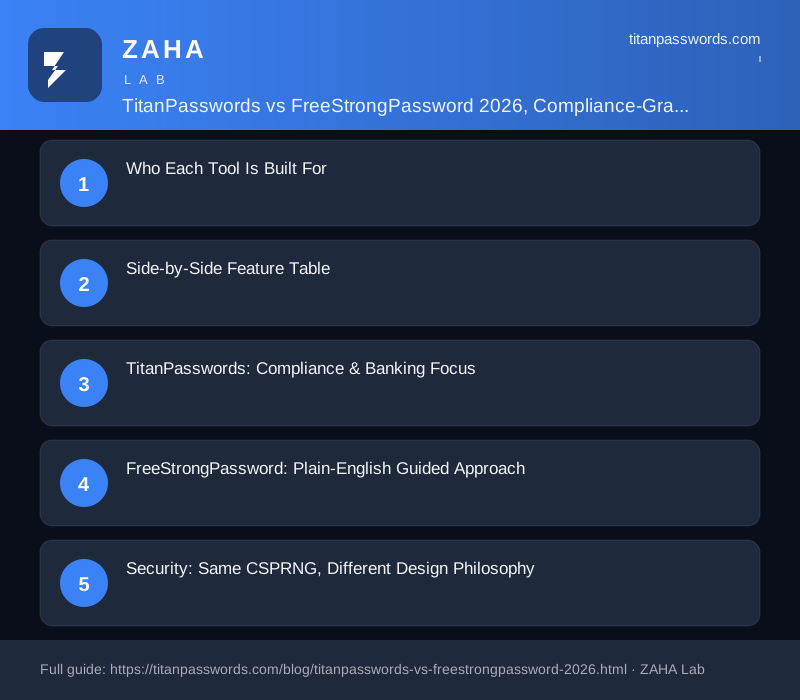
Who Each Tool Is Built For
The same cryptographic engine sits beneath both tools, but the product choices made around it reveal completely different intended audiences. Understanding this prevents two distinct mistakes: routing an enterprise compliance requirement through a consumer wizard, or sending a nervous first-timer to a tool that greets them with PCI-DSS requirement numbers.
TitanPasswords is designed for IT administrators, CISOs, compliance officers, and regulated-industry professionals who need documented evidence of standards-aligned credential generation. Its banking account-type presets, Personal Banking (20 characters), Investment Platform (24 characters), Trading Account (28 characters), Business Banking (32 characters), map directly to the length requirements in PCI-DSS v4.0 Requirement 8.3.6, NIST SP 800-63B 2025, and FCA Operational Resilience guidance. The live compliance panel shows, in real time, which frameworks a generated credential satisfies. The content library is built entirely around regulated-sector use cases: PCI-DSS deep dives, DORA password requirements, FFIEC authentication guidance, and incident response for financial accounts.
FreeStrongPassword is designed for the 67% of adults who still reuse passwords because they do not know how to make a strong one that they can remember (LastPass Psychology of Passwords 2025). Its three generation modes, guided wizard, quick random, and passphrase generator, address the primary obstacle between a non-technical user and a secure credential: not knowing where to start. The guided wizard asks simple questions ("What is this account for?", "Do you need to type it from memory?") and explains every setting in plain English. The passphrase generator produces word-combination credentials that are memorisable without sacrificing entropy. There is no compliance documentation, no technical jargon, and no assumption that the user has encountered NIST before.
Side-by-Side Feature Table
| Feature | TitanPasswords | FreeStrongPassword |
|---|---|---|
| Primary audience | Enterprise / banking / compliance | Families / beginners / first-timers |
| Entropy source | crypto.getRandomValues() | crypto.getRandomValues() |
| Server-side storage | None, fully client-side | None, fully client-side |
| Max password length | 128 characters | 64 characters (Quick mode) |
| Guided wizard | ❌ Not available | ✅ Step-by-step, plain English |
| Passphrase generator | ❌ Not available | ✅ Yes, memorable word combos |
| Banking-specific presets | ✅ 20–32 character banking presets | ❌ Not available |
| PCI-DSS v4.0 documentation | ✅ v4.0 mapped | ❌ Not provided |
| NIST SP 800-63B alignment | ✅ Documented | Implicit (entropy meets standard) |
| FCA guidance alignment | ✅ Documented | ❌ Not provided |
| Live compliance panel | ✅ Real-time framework check | ❌ Not available |
| Bulk generation | ✅ Team provisioning mode | ❌ Not available |
| Plain-English strength feedback | ❌ Technical (entropy bits) | ✅ Core design principle |
| Content library focus | Enterprise / compliance / financial | Beginner / family / consumer |
| Design palette | Dark gold/navy, enterprise | Warm green/friendly, consumer |
| Cost | Free | Free |
TitanPasswords: Compliance & Banking Focus
TitanPasswords is built around the question a compliance auditor asks, not the question a home user asks. The generator output is secondary to the compliance metadata: every preset is framed for which PCI-DSS v4.0 requirement it satisfies, what NIST SP 800-63B 2025 says about the length, and whether the credential meets FCA and FFIEC authentication standards. For an IT team that will present evidence in a compliance review, that framing removes hours of cross-referencing.
The banking-specific presets are the defining feature for regulated users. Personal Banking at 20 characters significantly exceeds the PCI-DSS v4.0 Requirement 8.3.6 minimum of 12 characters (with MFA) or 15 characters (without MFA). Business Banking at 32 characters provides a safety margin that exceeds every current financial regulatory minimum, including the NIST SP 800-63B 2025 update and FCA operational resilience requirements. Each preset comes with documented rationale, not just a length number.
Bulk generation separates TitanPasswords from most free tools. An administrator provisioning credentials for a new team can generate 5, 10, or 20 unique passwords simultaneously, each meeting the configured compliance rules, in a single session. For a security team onboarding new starters or rotating service account credentials across a financial system, this is not a convenience feature, it is a material reduction in provisioning time and the risk of human error in credential selection.
The maximum 128-character ceiling matters for service accounts, API keys, and legacy system requirements with unusual character-class constraints. The character-set toggles, uppercase, lowercase, digits, symbols, and ambiguous characters (0/O, 1/l/I), are independent, which matters for systems that reject specific characters or impose narrow class requirements that do not match standard generator outputs.
Where TitanPasswords is less suited: The tool assumes the user is already motivated to understand compliance frameworks. A household user who does not know what PCI-DSS means and does not need to will find TitanPasswords over-engineered. There is no wizard, no plain-English explanation of why password length matters, and no passphrase generator for users who need something memorisable.
FreeStrongPassword: Plain-English Guided Approach
FreeStrongPassword's design principle is that a secure password someone understands is better than a maximally secure one they will not use or will write on a sticky note. Every design decision, three generation modes, plain-English strength feedback, an accessible visual aesthetic, follows from that principle.
The guided wizard is the most distinctive feature. Rather than presenting a length slider and character toggles and expecting the user to know what to do with them, the wizard asks questions in plain language: what type of account is this for, does the user need to type it from memory, how often will it be changed. Each answer adjusts the output parameters and explains the reasoning in one sentence. A first-time user who has never encountered a password manager and does not know what "entropy bits" means can produce a contextually appropriate credential without reading any supporting documentation.
The passphrase generator addresses a specific failure mode that random character generators cannot: memorability. For master passwords, device open up credentials, and accounts where users must type the password manually, a four-word passphrase, "violet-anchor-circuit-flame", is both more memorable and, at 30+ characters, more resistant to brute force than a 12-character mixed-character password. FreeStrongPassword makes this option explicit and explains why passphrases work, not just that they work.
The quick random mode offers the fastest path to a strong credential for users who already understand what they need: a length slider (8–64 characters), character-class checkboxes, and a one-click copy. Strength feedback throughout uses plain language, "extremely strong," "would take millions of years to crack at current computing speeds", rather than entropy numbers that are accurate but opaque to a non-technical audience.
The content library mirrors the tool's audience: what is a data breach explained for families, child identity theft prevention, internet safety for summer holidays, passkeys explained for beginners, and parent guides to parental controls. None of it assumes existing security knowledge; all of it builds toward sustainable security habits.
Where FreeStrongPassword is less suited: There is no compliance documentation. An auditor asking for evidence of PCI-DSS-aligned credential generation will find nothing in FreeStrongPassword that satisfies that requirement. The quick mode ceiling of 64 characters is well beyond any practical cracking threshold but below TitanPasswords' 128-character maximum for environments with unusual technical requirements. There is no bulk generation mode for team provisioning.
Security: Same CSPRNG, Different Design Philosophy
The cryptographic foundation is identical. Both tools call crypto.getRandomValues() from the W3C Web Crypto API. On Linux this draws from /dev/urandom seeded from hardware entropy; on Windows from CNG; on macOS from Fortuna. These implementations satisfy FIPS 140-2 entropy source requirements and NIST SP 800-90A approved DRBG seeding. A 20-character output from either tool contains approximately 131 bits of entropy, well beyond the reach of any current or foreseeable brute-force attack.
The difference is not in the generation itself but in how each tool communicates the security properties of its output:
- TitanPasswords translates entropy into compliance evidence: this credential satisfies PCI-DSS v4.0 Requirement 8.3.6, it meets NIST SP 800-63B length requirements, it is documented against FCA guidance. The output of the tool is evidence for an audit, not just a password.
- FreeStrongPassword translates entropy into human meaning: this password would take millions of years to crack on current hardware, this passphrase is easier to remember than a random string and stronger than a short complex password. The output of the tool is a decision the user can understand, not just a number.
For team deployments where generated credentials need to be stored and managed at scale, Keeper Security for Business provides zero-knowledge encrypted storage with audit logging that extends TitanPasswords' compliance posture from generation through storage, covering the credential lifecycle that a generator alone cannot address.
Head-to-Head Verdict
Choose TitanPasswords if:
- You are an IT administrator, CISO, or compliance officer in banking, payments, healthcare, or government contracting.
- You need credential generation that maps explicitly to PCI-DSS v4.0, NIST SP 800-63B, ISO 27001 Annex A 5.17, FCA guidance, or FFIEC standards, with documented evidence.
- You need to generate multiple credentials simultaneously for team provisioning or service account rotation.
- You need passwords up to 128 characters with granular character-set control for legacy systems or unusually restrictive requirements.
- You want enterprise security intelligence alongside the generator: compliance deep dives, breach analysis, financial-sector threat intelligence.
Choose FreeStrongPassword if:
- You are setting up password security for a household, including children or older relatives who are new to the concept.
- You need a step-by-step guided wizard that explains each setting in plain language without assuming prior knowledge.
- You need a passphrase generator for a master password, device open up credential, or any account where you must type the password from memory.
- You want accessible, jargon-free strength feedback that explains why a credential is strong, not just that it is.
- You are building security habits from scratch and need guidance, not just a tool.
There is no scenario in which either tool produces a weaker password than the other at the same length. The only wrong choice is using the wrong tool for the wrong context: sending a compliance officer to a family wizard, or expecting a first-timer to interpret a PCI-DSS compliance panel.
The Essential Pairing: A Zero-Knowledge Password Manager
Generating a cryptographically secure credential solves the creation problem. Storing it is a separate and equally critical problem that neither tool addresses by design, and the wrong storage choice undoes everything the generator accomplished.
For enterprise teams building on TitanPasswords' compliance foundation, Keeper Security for Business extends the compliance posture end-to-end. Zero-knowledge encryption means credentials at rest are unreadable even if Keeper's infrastructure is compromised. Role-based access control satisfies least-privilege requirements. Audit logging provides the evidence trail that regulated environments require beyond the generation stage, covering the credential lifecycle that PCI-DSS v4.0 Requirement 8 extends from creation through access and revocation.
For household users and consumer accounts built on FreeStrongPassword's accessible design, NordPass maintains a consistent zero-knowledge philosophy with an interface designed for non-technical users. Credentials are encrypted client-side before synchronisation, NordPass employees cannot read vault contents. The family plan covers multiple household members under one subscription. The data breach scanning feature flags stored credentials against known-compromised databases, a natural complement to a tool that already prioritises plain-English security education.
The combination of a CSPRNG generator and a zero-knowledge password manager addresses both primary failure modes in credential security: weak or guessable passwords at creation (solved by the generator) and credential reuse or plaintext storage (solved by the manager). Neither tool works correctly without the other half of the stack.
FAQs
Does TitanPasswords produce stronger passwords than FreeStrongPassword?
No, both use crypto.getRandomValues(), the browser's CSPRNG. At the same length, the entropy quality is identical: a 20-character output from either tool contains approximately 131 bits of entropy. TitanPasswords supports up to 128 characters with banking presets; FreeStrongPassword's quick mode goes to 64 characters. Neither is cryptographically superior at equivalent lengths. The differences are in compliance documentation, available features, and intended audience, not the randomness of the output.
Which tool should a family use to teach children about password safety?
FreeStrongPassword. Its guided wizard walks first-time users through password creation in plain English, explains strength in accessible terms rather than entropy bits, and includes a passphrase generator suitable for children learning to create memorable-but-strong credentials. TitanPasswords uses financial compliance terminology throughout, PCI-DSS v4.0, NIST SP 800-63B, FCA guidance, which is neither appropriate nor useful in a household security education context.
Can FreeStrongPassword generate passwords that meet PCI-DSS v4.0 requirements?
Technically yes, a 16-character random password from FreeStrongPassword's quick mode exceeds the PCI-DSS v4.0 Requirement 8.3.6 minimum length of 12 characters (with MFA). However, FreeStrongPassword provides no compliance documentation, framework mapping, or evidence trail. In a regulated environment, an auditor requires both the correct credential and documented proof of compliance-aligned generation. TitanPasswords is designed for environments where the documentation matters as much as the output.
Does TitanPasswords work for non-technical home users?
It can, but it is not designed for that use case. TitanPasswords assumes the user understands or is motivated to learn about financial compliance frameworks. For a home user who wants a strong password without reading about PCI-DSS, FreeStrongPassword's wizard is faster and more accessible, and produces an equally secure result at standard lengths. TitanPasswords is over-engineered for consumer use; FreeStrongPassword is under-documented for regulated use.
What is the best password manager to pair with TitanPasswords or FreeStrongPassword?
For enterprise users pairing with TitanPasswords, Keeper Security for Business provides zero-knowledge encryption, role-based access control, audit logging, and breach-watch monitoring that extend the compliance posture from generation through storage. For household users pairing with FreeStrongPassword, NordPass provides the same zero-knowledge architecture in an interface designed for non-technical users, with a family plan and breach-scanning that alerts when stored credentials appear in known data dumps.
Affiliate Disclosure: This post may contain affiliate links. If you purchase through these links, we earn a small commission at no extra cost to you. Our password generator is free to use. Full disclosure.